A Square for Passing Through or Staying Awhile?
Public square design can reveal whose routes matter and where people can pause. Learn to read its edges, entrances, and daily rhythms before judging the layout.
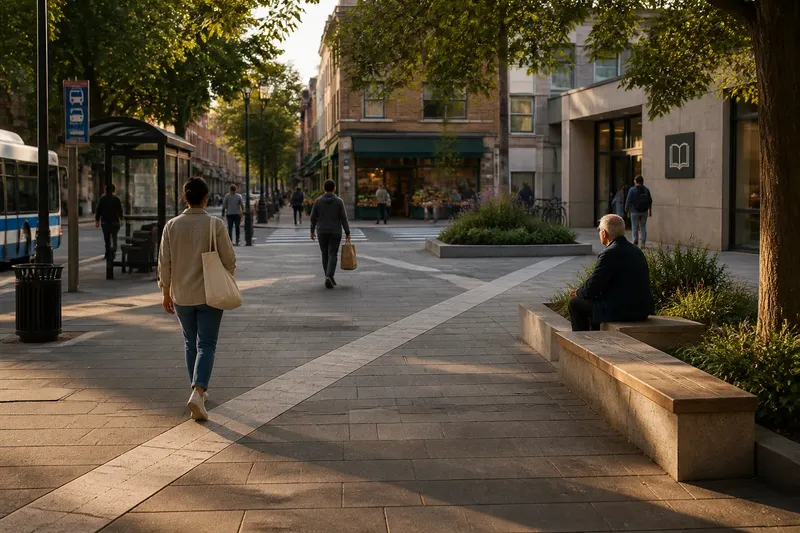
Is public square design helping you get somewhere, or making it possible to stay? At a corner where a bus stop, a library, and a narrow neighborhood street meet, the answer may be written in a worn diagonal across the paving—and in whether anyone can sit without being in the way.
That diagonal is more than a shortcut. It records how the square connects to the blocks around it. The useful question is not whether the space looks orderly from above, but whether its route and its edges make sense for the people who arrive from those streets.
Routes leave traces
People often reveal a square’s real geography by where they enter and where their feet carry them. A path worn through grass, a gap between planters, or a steady stream crossing one corner may show that the designed route does not match the direct connection people need.
In a place-name context, that difference matters. A square may be named for a market, a station, or a local figure, but its daily role comes from the streets and destinations attached to it. Its layout can either reinforce those connections or make the named place feel oddly detached from its neighborhood.
Look at the approaches, not just the open center. Do sidewalks meet the square naturally? Can someone cross toward a shop entrance without threading between chairs? A route that is clear on a plan can become awkward when a delivery cart, event barrier, or planting bed occupies its most useful point.
Edges tell the story
The boundary between a square and its surrounding blocks often determines whether people treat it as a room, a shortcut, or an island. A library door, a café window, a low wall, and a tree canopy each connect the public space to nearby activity in a different way.
Edges can also expose a mismatch between the square’s official identity and its ordinary use. A broad civic plaza may be named for a historic event, yet remain empty between ceremonies if its surrounding frontages offer no reason to stop. Conversely, a modest paved corner beside a grocery store can become a familiar meeting point because its entrances and foot traffic keep it legible.
Seats belong where stopping does not interrupt the most direct route. A bench with a back may suit a longer wait; a broad step or ledge may support a brief pause. Shade, shelter, and a view toward an entrance can make a seat useful without turning the whole square into a lounge.
One route, two rhythms
A square can accommodate both movement and pause if those uses have distinct, readable places. Keep a direct connection between the main entrances, then use an edge for seating, planting, or a small gathering area. The point is not to divide people into strict lanes. It is to avoid making someone choose between blocking a path and having nowhere to rest.
Say a neighborhood square sits between a bus stop on its north side, a grocery store to the east, and a library to the south. Imagine the paving runs straight from the bus stop toward the two doorways, while a bench and a low planter sit beside the library wall. A person carrying groceries can take the direct route; someone waiting for a ride can sit off it. The tradeoff is that the central area has less room for a large event, but ordinary arrivals and waits have clearer places.
Movable chairs can add flexibility, but their location needs thought. If they drift into an entrance or accessible route, the square’s choices become obstacles. A defined storage spot and a surface that does not slope toward the path help keep the arrangement understandable.
Reading a square?
How do you spot a desire line?
Watch where people enter and the direction they continue, then compare those paths with the paved routes. If many people repeatedly take the same direct crossing, a planter or barrier may be interrupting a useful connection; if paths scatter, the site may need clearer entrances rather than a single forced line.
Where should seating go?
Look for an edge with a view of activity and room to sit outside the main route. If people pause beside a doorway or on a narrow path, provide a nearby resting place; if seats already sit empty, check whether exposure, noise, or poor orientation makes them uninviting before adding more.
What does a square’s name tell you?
A name can point to a civic history or former use, while the surrounding streets show how the place functions now. If the name refers to a market but the edges no longer support everyday exchange, consider whether the layout preserves any practical connection to that identity; if it does, the name may remain legible through current use.
How can you judge a layout on an ordinary day?
Observe the square when no market or performance is scheduled, noting entrances, pauses, and conflicts between movement and furniture. If the space works only during events, favor everyday routes and places to wait; if ordinary use is already clear, protect those patterns when considering changes.
Check the local fit
A quick observation is more useful when it ends in a decision. For each item below, note what you actually see, then choose the action that follows from that observation.
- Entrances: Check whether the main sidewalks lead directly into usable paths. If they do, preserve those connections; if a barrier or planter blocks them, consider shifting the obstruction rather than adding paving elsewhere.
- Crossing lines: Check whether people repeatedly cut across one part of the square. If a clear shared route emerges, keep it open; if routes conflict with seating or deliveries, separate the uses or adjust the location of the obstruction.
- Waiting places: Check whether people stand in doorways or narrow paths while they wait. If they do, consider a nearby seat or clear standing area; if they already have comfortable options, avoid filling another edge with furniture.
- Seat conditions: Check whether existing benches have shade, shelter, or a useful view. If they are exposed or face away from activity, improve their setting or orientation; if they are comfortable but unused, look for another reason people avoid that edge.
- Street connections: Check whether nearby destinations have visible entrances from the square. If doors and shopfronts connect naturally, protect those approaches; if blank walls dominate, focus any gathering area near the active frontage instead.
- Event conflicts: Check whether event equipment blocks an everyday route. If it does, set aside an event area that leaves the connection clear; if events fit without blocking movement, retain that flexible arrangement.
- Ordinary use: Check what the square offers when no programmed activity is underway. If there is no reason to pause, add a practical edge use such as seating or shade; if people already meet and rest there, protect the features supporting those habits.
For a proposed physical change, local accessibility requirements, site conditions, and the responsible agency’s guidance matter. Questions about construction or public safety belong with qualified professionals, who can assess the site rather than relying on a sketch and good intentions.
Choose by context
A crossing-focused layout makes sense where the square joins busy streets, transit, shops, or civic entrances and people need a direct connection. A pause-focused layout fits where the surrounding blocks offer few comfortable places to wait or gather. Many squares need both, but a narrow site may require a clear priority.
Compare the square with what the neighborhood already provides. If nearby sidewalks have benches and sheltered storefronts, the square may be more valuable as a legible connection. If fast or exposed streets make stopping difficult, a protected edge may fill a gap that the rest of the block does not.
Public square design is easiest to judge from the routes and routines around it, not from the name on a sign or the symmetry of a plan. Read the entrances, observe where people pause, and ask which connection or resting place is missing. The most useful change may be modest: moving one barrier, turning one bench, or leaving a familiar diagonal open.